
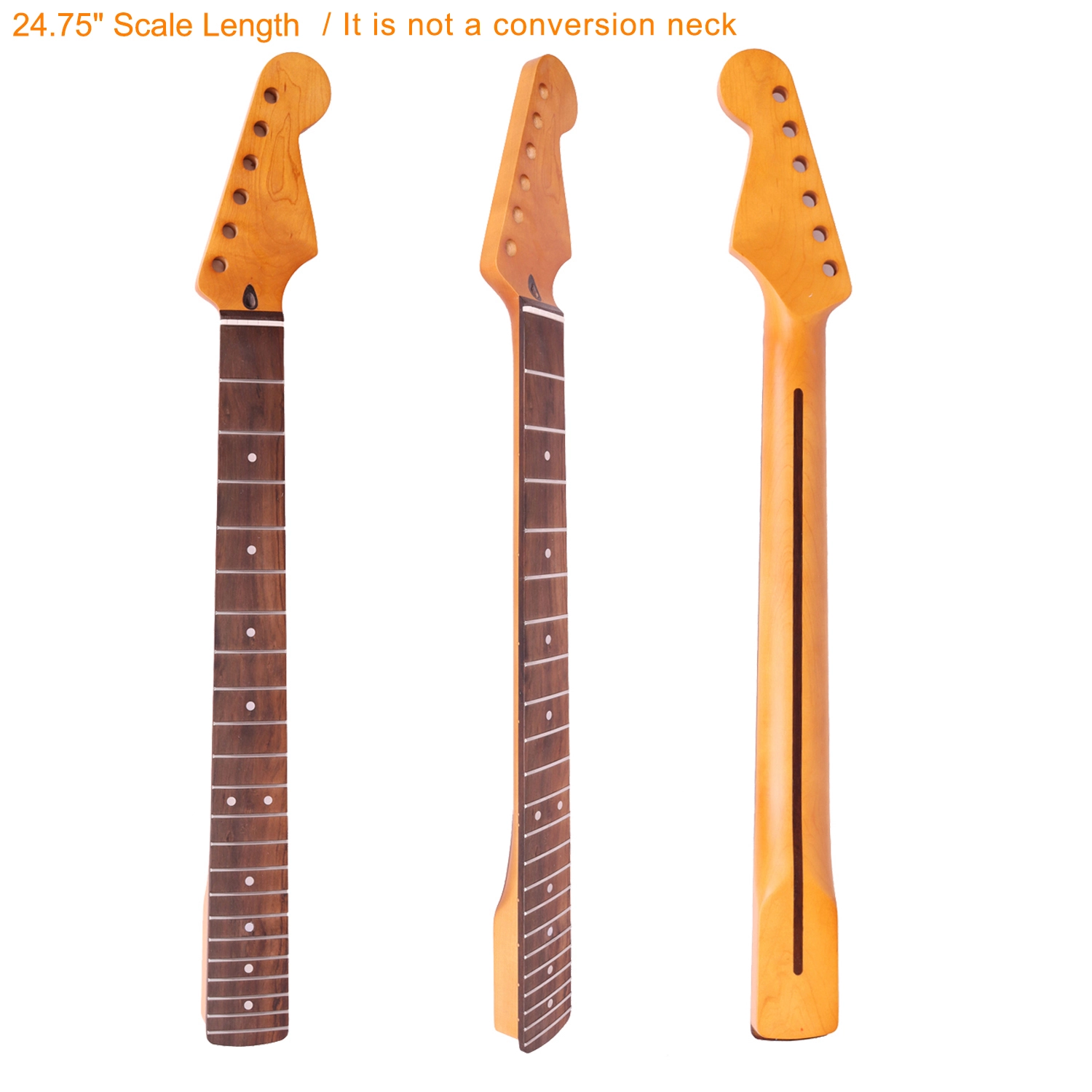
24.75" Scale Length Stratocaster Compatible Guitar Neck Rosewood
Frets: 22 Frets Medium-Jumbo Neck: Canadian Maple Neck fretboard: Rosewood fretboard Radius:12
View productMost neck decisions come down to three questions: what the wood is, how it was cut, and whether the numbers line up with the body already on your bench. This guide works through one specific quarter-sawn wenge guitar neck — rosewood board, 22 medium-jumbo stainless frets, 9.5" radius, satin finish — and shows where it earns its place in a partscaster build, so you can judge whether it is the right telecaster guitar neck for the guitar you are putting together.


Quarter-sawn describes how the board was cut, not a finish or a marketing badge. The blank is sliced so the growth rings run close to perpendicular to the face of the neck, which spreads seasonal movement across the width instead of letting it gather in one direction. It is the cut builders reach for when they want a neck least likely to twist or wander once the guitar leaves the bench.
On a bolt-on Tele-style guitar that matters in a very practical way. The neck is a long, thin, unsupported span, and any movement shows up as drifting action, buzzy frets or a truss rod that needs another quarter turn. This neck is cut from quarter-sawn black wenge and paired with a dual action truss rod that the product page notes can be adjusted to correct both concave and convex bending — a blank that starts stable, plus a rod that can bring it back if the weather wins anyway.
These are the dimensions listed on the current product page for SKU PTLWR2401022M. Measure your body, your tuners and your nut before you commit — the wood is the interesting decision, but the fit is the one that stops a build.

Both figures appear on the listing; $139.00 is the price currently shown. Select Ships From: Outside US before adding to cart.
| SKU | PTLWR2401022M |
|---|---|
| Neck wood | Quarter Sawn Black Wenge |
| Fretboard | Rosewood |
| Frets | 22 medium-jumbo stainless steel |
| Fretboard radius | 9.5" / 240 mm |
| Scale length | 25.5" / 648 mm |
| Nut width | 1.69" / 43 mm |
| Heel width | 2.2" / 56 mm |
| Heel depth | 1.0" / 26 mm |
| Peg hole diameter | 10 mm |
| Thickness at 1st fret | 0.82" / 21 mm |
| Thickness at 12th fret | 0.87" / 22 mm |
| Truss rod | Dual action |
| Finish | Satin |
| Colour | Nature |
Tone words are vocabulary, not measurements. Treat the descriptions below as a starting point, then let your own amp and hands make the final call.

The product page describes this wenge neck as relatively bright with a superb mid-range, a resonant low end, a bright top end and clear articulation. It also notes that the rosewood fretboard adds brightness on top of that — the board is not there to darken the voice, it keeps the top end open.
In practice that reads as a neck with snap and definition. Chords keep their shape when you dig in, single notes push through a dense mix, and the response stays lively under overdrive rather than collapsing into mush. If you are chasing a softer, rounder attack, a different wood family will suit you better than this one.
Dense and dark-grained, with the bright-leaning response the listing describes: strong mid-range, a resonant low end and articulation that survives gain.
A traditional pairing on countless Tele-style guitars. The page states it adds brightness, which keeps the neck's top end present instead of rounding it off.

The neck carries 22 medium-jumbo stainless steel frets — tall enough to give you something to grip on a bend, not so tall that every chord feels sharp under your fingers. Stainless is the harder of the two common fret materials, so it keeps its shape and its polish far longer than nickel silver, which is why it turns up on master build necks.
The listing walks through the fretwork step by step: leveling, crowning and beveling the fret ends. That is the sequence that decides whether a neck feels finished or raw. Level frets stop buzz, the crown restores the playing surface, and beveled ends keep the fretboard edges from catching your hand on the way up the neck.
One practical note carried from the page: minor fret dressing or leveling may be necessary to compensate for environmental shifts during shipping, or to hit a specific very low action. If you set your action low, budget one visit to your own tech.
Three measurements decide whether this neck works with your build. Check the heel pocket, the peg hole size and the scale length before you order.

The heel is listed at 2.2" / 56 mm wide and 1.0" / 26 mm deep, which is the shape to compare against your body's neck pocket. The scale is 25.5" / 648 mm — if your body is drilled and positioned for a shorter scale, the bridge will not intonate no matter how well the heel fits.
The peg holes are 10 mm, so check the bushing or collar diameter of the tuners you already own. Nut width is 1.69" / 43 mm, the standard Tele-style figure, and the profile runs 0.82" / 21 mm at the first fret to 0.87" / 22 mm at the twelfth.
Four common situations, each tied to a real number on this neck and the decision it implies.
A quarter-sawn black wenge neck with a rosewood board, 9.5" radius and a satin finish covers the ground most players actually use. It is not a bargain-bin blank, and it is not custom-shop money either.
Rooms change humidity, humidity changes necks, and necks that move force you back to the truss rod cover mid-set. The quarter-sawn cut plus a dual action rod is the combination that gives you the most room to correct.
Hardware you already have is money already spent. Before ordering, put calipers on the bushing and post collar of your tuners and compare them with the 10 mm peg holes.
Stainless medium-jumbo frets resist wear far better than nickel silver, and the level-crown-bevel sequence gives you a clean starting surface. The page still flags environmental shifts in transit as a reason for a possible touch-up.
The listing runs on a single product page with a ships-from selector, a quantity field and the usual cart shortcuts. Follow the order below and nothing gets missed.
The listing pairs this neck with Tuners 6 Right Handed — 1:18 ratio tuning key pegs with hexagonal knobs in black finish, which matches the 10 mm peg holes without extra hardware hunting.
Building several guitars or ordering for a workshop? Contact the team with your quantities and spec questions before you place the order.
Keep adjacent product options together for a faster catalog comparison.
Frets: 22 Frets Medium-Jumbo Neck: Canadian Maple Neck fretboard: Rosewood fretboard Radius:12
View product
It is a conversion neck, fits on standard 25.5
View product
TWT GUITARS 4 Strings Jazz Bass guitar neck features roasted maple, satin finish, 34″ scale, 20 frets, 12″ radius, and 18 mm holes—pro-grade feel and tone.
View productReview the product details, images, and specifications presented on the official product page.
Use the application and use-case information published on the official product page.
Confirm the specifications and options listed for the exact product variant before placing an order.
Check the official product page or ask the supplier about options shown for the selected product.
Use the official contact or inquiry path provided on the site.
Include the product page, intended use, required quantity, and any specifications you need the supplier to review.
Copyright © 2021-2025 TWT GUITARS All Rights Reserved. POWERED BY UEESHOP


